Mastering Generative AI Integration for WhatsApp Growth
- Albert Hilton
- May 4
- 5 min read
In today's hyper-connected digital landscape, businesses that aren't leveraging generative AI integration services for WhatsApp are leaving significant growth on the table. With over 2.7 billion active users globally, WhatsApp has evolved far beyond a simple messaging app; it's now a powerful business channel. Combine it with the transformative potential of generative AI, and you have one of the most potent customer engagement tools available today.
Whether you're a startup scaling fast or an enterprise looking to automate customer communication, this guide walks you through everything you need to know about WhatsApp AI integration, from strategy to execution.
Why Generative AI and WhatsApp Are the Perfect Business Partnership
The marriage of generative AI and WhatsApp isn't just convenient; it's transformational. Traditional WhatsApp Business tools offered basic auto-replies and catalogs. Generative AI takes this several steps further by enabling context-aware conversations, dynamic content generation, and personalized engagement at scale.
Businesses using AI-powered WhatsApp solutions report measurable improvements across key metrics: higher open rates (WhatsApp messages boast 98% open rates vs. 20% for email), faster response times, and dramatically reduced support costs. Generative AI models like large language models (LLMs) can understand nuanced customer queries, generate human-like responses, and even proactively push relevant content, all without human intervention.
The result? A channel that works 24/7, speaks your brand's language, and scales infinitely.

Key Generative AI Integration Services for WhatsApp
Not all generative AI integration services are created equal. The right stack depends on your business goals, existing infrastructure, and the complexity of customer interactions you need to handle.
Here are the core services driving WhatsApp AI transformation:
1. Conversational AI Chatbots: Powered by LLMs, these bots go beyond scripted flows. They understand intent, handle multi-turn conversations, and escalate to human agents only when necessary. Platforms like Meta's WhatsApp Business API, combined with AI backends such as OpenAI GPT or Anthropic Claude, make this possible at enterprise scale.
2. Natural Language Processing (NLP) Pipelines: NLP layers parse incoming messages to extract intent, sentiment, and entities. This powers smarter routing, better FAQ handling, and real-time personalization, cornerstones of any serious WhatsApp growth strategy.
3. AI-Driven Campaign Automation: Send contextually relevant promotional messages, reminders, and nurture sequences—all generated and timed by AI based on user behavior data. This transforms WhatsApp from a reactive support tool into a proactive revenue channel.
4. Voice-to-Text and Multilingual AI: For markets like India, Brazil, and Southeast Asia, where voice messages are common, AI transcription and multilingual response generation remove language barriers and improve inclusivity.
5. CRM and Backend Integration: Connect WhatsApp AI to your CRM, order management, or helpdesk tools. Generative AI can pull live order data, summarize case histories, and update records all within a single WhatsApp thread.
How to Build a WhatsApp AI Growth Strategy That Actually Works
A successful WhatsApp generative AI strategy isn't about plugging in a chatbot and hoping for the best. It requires deliberate planning around four pillars:
Define Your Use Cases First: Start with your highest-volume, lowest-complexity interactions—FAQs, order status checks, and appointment reminders. These offer the fastest ROI and give your AI model clean, repetitive training signals. Then layer in more complex workflows like personalized product recommendations or dynamic upselling.
Choose the Right Integration Architecture: For most businesses, the optimal architecture involves the WhatsApp Business API (via a Meta-approved BSP), a middleware layer for AI logic, and connections to backend systems. Cloud-native deployments on AWS, Azure, or GCP offer the scalability needed for high-message-volume environments.
Train and Fine-Tune Your AI Model: Generic LLMs are powerful, but fine-tuned models trained on your brand voice, product catalog, and past customer conversations will dramatically outperform out-of-the-box solutions. Invest in quality training data from day one.
Set Up Feedback Loops: AI improves with feedback. Implement CSAT surveys at conversation end, track escalation rates, and monitor unresolved query patterns. Feed these insights back into model retraining on a regular cycle.
Measuring WhatsApp AI Integration Success: Metrics That Matter
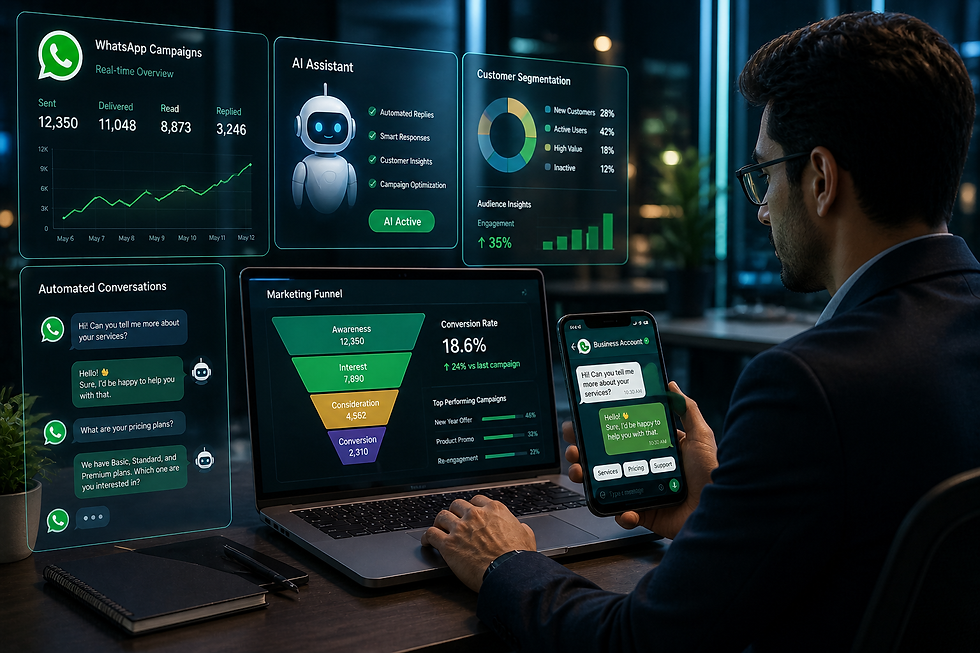
Deploying AI for WhatsApp business growth is only half the battle; measuring impact is where strategy gets refined. Track these KPIs religiously:
Containment Rate: The percentage of conversations fully resolved by AI without human handoff. A healthy target is 70–85% for well-trained models.
First Response Time (FRT): AI should bring this to under 5 seconds consistently.
Customer Satisfaction Score (CSAT): Benchmark against your pre-AI baseline and aim for a 10–15% improvement within the first quarter.
Conversation-to-Conversion Rate: For sales-focused deployments, track how many AI conversations result in a purchase, booking, or lead qualification.
Message Opt-Out Rate: A spike here signals your AI is sending irrelevant or intrusive content—a prompt signal to recalibrate your campaign logic.
Reporting dashboards integrated with your WhatsApp Business API data and AI platform give real-time visibility into all of these, enabling agile iteration.
Common Pitfalls to Avoid When Integrating Generative AI with WhatsApp
Even well-resourced teams stumble. Here are the mistakes most commonly seen in WhatsApp AI integration projects and how to sidestep them:
Over-automating too early: Deploying AI across all conversation types before it's adequately trained leads to poor experiences. Start narrow, go deep, then expand.
Ignoring compliance: WhatsApp has strict opt-in and messaging policy rules. Generative AI systems must be designed to enforce these natively, not as an afterthought. GDPR and regional data privacy laws add further complexity for international deployments.
Neglecting the human handoff: AI should enhance human agents, not replace them entirely. A seamless escalation path, with full conversation context passed to the agent, is non-negotiable for complex or sensitive interactions.
Underinvesting in prompt engineering: The quality of your AI's responses is only as good as the prompts and system instructions guiding it. This is a craft that deserves dedicated attention and iteration.
Frequently Asked Questions (FAQs)
Q: What is generative AI integration for WhatsApp?
Generative AI integration for WhatsApp involves connecting large language models and AI services to the WhatsApp Business API to automate and enhance customer conversations, from support queries to personalized marketing.
Q: Do I need the WhatsApp Business API for AI integration?
Yes. The standard WhatsApp Business app has limited automation capabilities. The Business API (accessed via Meta-approved BSPs) is required for enterprise-grade AI integration, bulk messaging, and CRM connectivity.
Q: How long does it take to implement a WhatsApp AI solution?
A basic AI chatbot can be live in 2–4 weeks. A fully integrated, fine-tuned solution with CRM connectivity and custom AI models typically takes 8–16 weeks depending on complexity.
Q: Is WhatsApp AI integration suitable for small businesses?
Absolutely. Several BSPs and SaaS platforms offer no-code or low-code WhatsApp AI tools designed specifically for SMBs, with pricing that scales with usage.
Q: How does generative AI differ from a rule-based WhatsApp chatbot?
Rule-based bots follow fixed decision trees and can only handle anticipated inputs. Generative AI understands natural language, handles unexpected queries, and generates dynamic responses, making it far more effective for real-world conversations.
Q: What industries benefit most from WhatsApp AI integration?
E-commerce, healthcare, banking, travel, and education are leading adopters. Any industry with high inbound query volume or a need for personalized communication at scale stands to benefit significantly.
Ready to Unlock WhatsApp Growth with Generative AI?
The businesses winning on WhatsApp in 2026 and beyond aren't just those with the most followers; they're the ones deploying intelligent, scalable generative AI integration services that turn every conversation into an opportunity.
Whether you're exploring your first chatbot deployment or looking to overhaul a legacy system with cutting-edge AI, the roadmap is clear: start with strategy, choose the right integration architecture, measure relentlessly, and iterate fast.
Don't wait for your competitors to master this first. Partner with an experienced generative AI integration team today and transform your WhatsApp channel into your highest-performing customer touchpoint.


Comments